
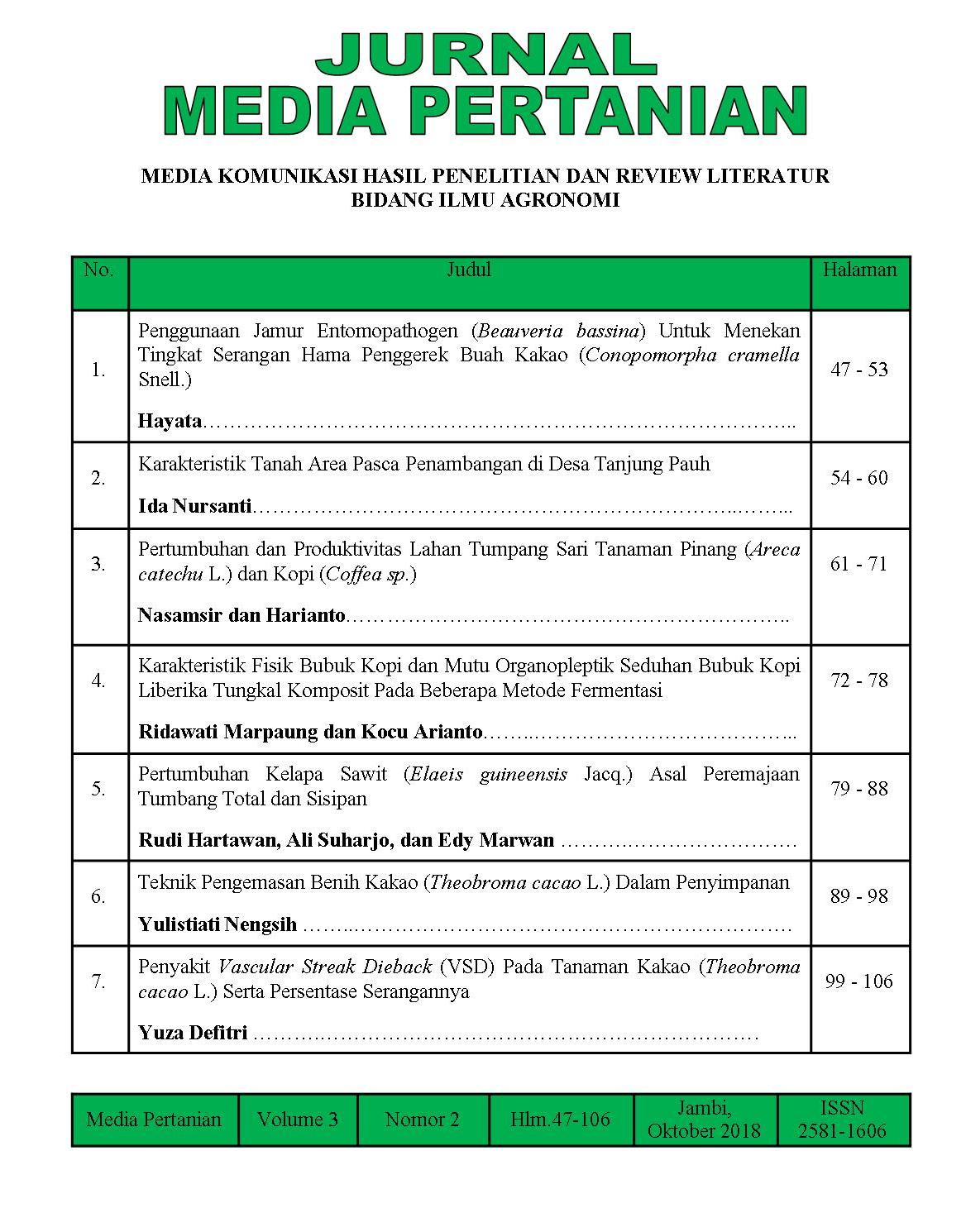

Kajian Ketahanan Penetrasi Tanah Akibat Residu Frekuensi Pemupukan Anorganik Pada Tanah Ultisol Perkebunan Kelapa Sawit
Abstract
Keywords
Full Text:
PDFReferences
Alhai, D. P., Syakur, S., & Basri, H. (2021). Ketahanan penetrasi tanah pada penggunaan lahan hortikultura di Saree Kabupaten Aceh Besar. Jurnal Ilmiah Mahasiswa Pertanian, 6(4), 680–690.
Alaoui, A., Rogger, M., Peth, S., & Blöschl, G. (2018). Does compaction increase floods? A review. Journal of Hydrology, 557, 631–642.
Bengough, A. G., et al. (2019). Root elongation, strengthening and penetrating ability in compacted soils. Plant and Soil, 445(1), 199–211.
Blanco-Canqui, H., & Ruis, S. J. (2020). Cover crop impacts on soil physical properties: A review. Soil Science Society of America Journal, 84(5), 1527–1576.
Colombi, T., Torres-Guerrero, R., Kirchgessner, N., Walter, A., & Keller, T. (2018). Penetration resistance along a soil profile determines root growth and crop yield. Geoderma, 318, 91–101.
Correa, J., Postma, J. A., Watt, M., & Wojciechowski, T. (2019). Soil compaction and the architectural plasticity of root systems. Agronomy, 9(6), 312.
Darras, K. F., et al. (2021). Canopy cover and understory vegetation buffer microclimate in oil palm plantations. Agricultural and Forest Meteorology, 307, 108486.
Ding, W., Zvomuya, F., Cao, M., Wu, Y., Liu, Z., & He, H. (2024). Ground cover management improves orchard soil moisture content: A global meta-analysis. Journal of Hydrology, 633, 130710.
Dislich, R., et al. (2017). A review of the ecosystem functions in oil palm plantations, using forests as a reference system; Biological Reviews, 92(3), 1539–1569.
Formaglio, G., et al. (2021). Nutrient management affects soil physical and chemical degradation in oil palm smallholder plantations. Soil Use and Management, 37(4), 812–824.
Gao, W., et al. (2022). Combined effects of soil bulk density and matric potential on soil mechanical strength and root penetration. Soil and Tillage Research, 215, 105218.
Gaveau, D. L. A., et al. (2022). Long-term impacts of land-use management on soil physical degradation in Southeast Asian oil palm landscapes. Global Environmental Change, 73, 102480.
Guillaume, T., Kotowska, M. M., Hertel, D., & Kuzyakov, Y. (2018). Carbon costs and benefits of oil palm expansion in Central Sumatra. Ecology Letters, 21(5), 663–674.
Hassler, E., Corre, M. D., Kurniawan, S., et al. (2022). Mulching with pruned fronds promotes the internal soil N cycling and soil fertility in a large-scale oil palm plantation. Biogeochemistry, 159, 135–154. DOI: 10.1007/s10533-021-00798-4.
Hidayat, F., Pane, R. D. P., Sapalina, F., Listia, E., Koga, T., Winarna, Lubis, M. E. S., Oshiro, M., Sakai, K., Utami, S. N. H., & Tashiro, Y. (2024). Long-term application of organic matter improves soil properties and plant growth-promoting bacteria in soil communities of oil palm plantation. Soil Science and Plant Nutrition, 70(5–6), 393–405. DOI: 10.1080/00380768.2024.2380881.
Ito, R., Yanai, J., & Nakao, A. (2023). Interactive effect of parent material and topography on spatial variability of paddy soil material characteristics in the alluvial plain.
Jakhar, G. L., Sharma, P., Sharma, K. R., Sharma, V., Abrol, V., Sharma, M., & Sharma, N. (2019). Soil bulk density as a soil physical health indicator under different land use systems. Journal of Soil and Water Conservation, 18(4), 326–333.
Keller, T., et al. (2019). Historical increase in agricultural machinery weights enhances subsoil compaction. Proceedings of the National Academy of Sciences, 116(24), 11549–11554.
Lardy, J. M., DeSutter, T. M., Daigh, A. L. M., Meehan, M. A., & Staricka, J. A. (2022). Effects of soil bulk density and water content on penetration resistance. Agricultural & Environmental Letters, 7(2), e20096. DOI: 10.1002/ael2.20096. (ResearchGate)
Manning, P., et al. (2020). Long-term effects of inorganic fertilization on soil physical architecture in tropical agroecosystems. Geoderma, 361, 114061. [Perlu verifikasi kembali karena data bibliografis belum berhasil dipastikan dari sumber yang tersedia.]
Mossadeghi-Björklund, M., et al. (2019). Pore space architecture control on air and water transport in compacted soils. Soil and Tillage Research, 191, 260–271.
Nelson, P. N., et al. (2020). Soil management in oil palm plantations: Balancing yield and environmental sustainability. Agroforestry Systems, 94(4), 1205–1219.
Poeplau, C., Don, A., & Six, J. (2021). Soil organic carbon stocks and turnover in tropical agricultural soils: A global meta-analysis. Global Change Biology, 27(8), 1630–1644.
Prabowo, N. E., Foster, H. L., Nelson, P. N., et al. (2023). Potassium and magnesium uptake and fertiliser use efficiency by oil palm at contrasting sites in Sumatra, Indonesia. Nutrient Cycling in Agroecosystems, 126, 263–278. DOI: 10.1007/s10705-023-10289-7.Pulido-Moncada, M., et al. (2021). Mechanical stresses in agricultural soils: Temporal dynamics of soil compaction under field traffic. Soil and Tillage Research, 205, 104781.
Rabot, E., Wiesmeier, M., Schlüter, S., & Vogel, H. J. (2018). Soil structure as an indicator of soil functions: A review of characterization and quantification metrics. Geoderma, 314, 122–137.
Rahman, N., Giller, K. E., de Neergaard, A., Magid, J., van de Ven, G., & Bruun, T. B. (2021). The effects of management practices on soil organic carbon stocks of oil palm plantations in Sumatra, Indonesia. Journal of Environmental Management, 278, 111446. DOI: 10.1016/j.jenvman.2020.111446.
Raza, S., et al. (2021). Root growth response to mechanical resistance and soil aeration status in tropical plantation crops. Plant, Cell & Environment, 44(9), 2980–2993.
Rounsevell, M. D. A., et al. (2021). Interactions between agricultural management, soil structure, and hydrology in tropical agro-ecosystems. Catena, 198, 105021. [Disarankan verifikasi judul dan penulis lengkap sebelum dimasukkan ke naskah final.]
Septiaji, E. D., Bimasri, J., & Amin, Z. (2024). Karakteristik sifat fisik tanah Ultisol berdasarkan tingkat kemiringan lereng. Agroradix: Jurnal Ilmu Pertanian, 7(2), 41–49.
Six, J., & Paustian, K. (2019). Aggregate dynamics and soil organic matter storage in agroecosystems. Soil Science Society of America Journal, 83(4), 981–995.
Tandon, P., et al. (2019). Litterfall dynamics and organic carbon inputs across different management zones in mature oil palm plantations. Biotropica, 51(3), 345–356.
Thoumazeau, A., Mettauer, R., Turinah, Junedi, H., Baron, V., Chéron-Bessou, C., & Ollivier, J. (2024). Effects of fertilization practices and understory on soil health and oil palm performances in smallholdings: An Indonesian case study. Agricultural Systems, 213, 103802. DOI: 10.1016/j.agsy.2023.103802.
Tuzzin De Moraes, M., et al. (2024). The impacts of cover crop mixes on the penetration resistance model of an Oxisol under no-tillage. Soil and Tillage Research, 242, 106138. DOI: 10.1016/j.still.2024.106138.
Whalley, W. R., et al. (2019). Penetration resistance in soil: Dependence on bulk density, water content and matric suction. European Journal of Soil Science, 70(5), 1011–1022.
Yu, et al. (2024). The effects of soil compaction on wheat seedling root growth are specific to soil texture and soil moisture status. Rhizosphere, 29, 100838. DOI: 10.1016/j.rhisph.2023.100838.
DOI: http://dx.doi.org/10.33087/jagro.v11i2.340
Refbacks
- There are currently no refbacks.

This work is licensed under a Creative Commons Attribution-ShareAlike 4.0 International License.
Jurnal Media Pertanian Published by Fakultas Pertanian Universitas Batanghari |
